Ask any Turkish pastry chef what they consider the most challenging dessert to make consistently well, and most will not say baklava. They will say kadayıf. Not because kadayıf is more complex in concept — it is, in some ways, simpler in structure than multi-layered baklava — but because the margin for error is so narrow, the variables so numerous, and the quality of the raw dough so critical. A batch of kadayıf made with slightly dry dough, or pressed a few seconds too long, or soaked in syrup at the wrong moment, becomes ordinary. Made correctly, it is among the most memorable things you will eat in your life.
What Kadayıf Actually Is
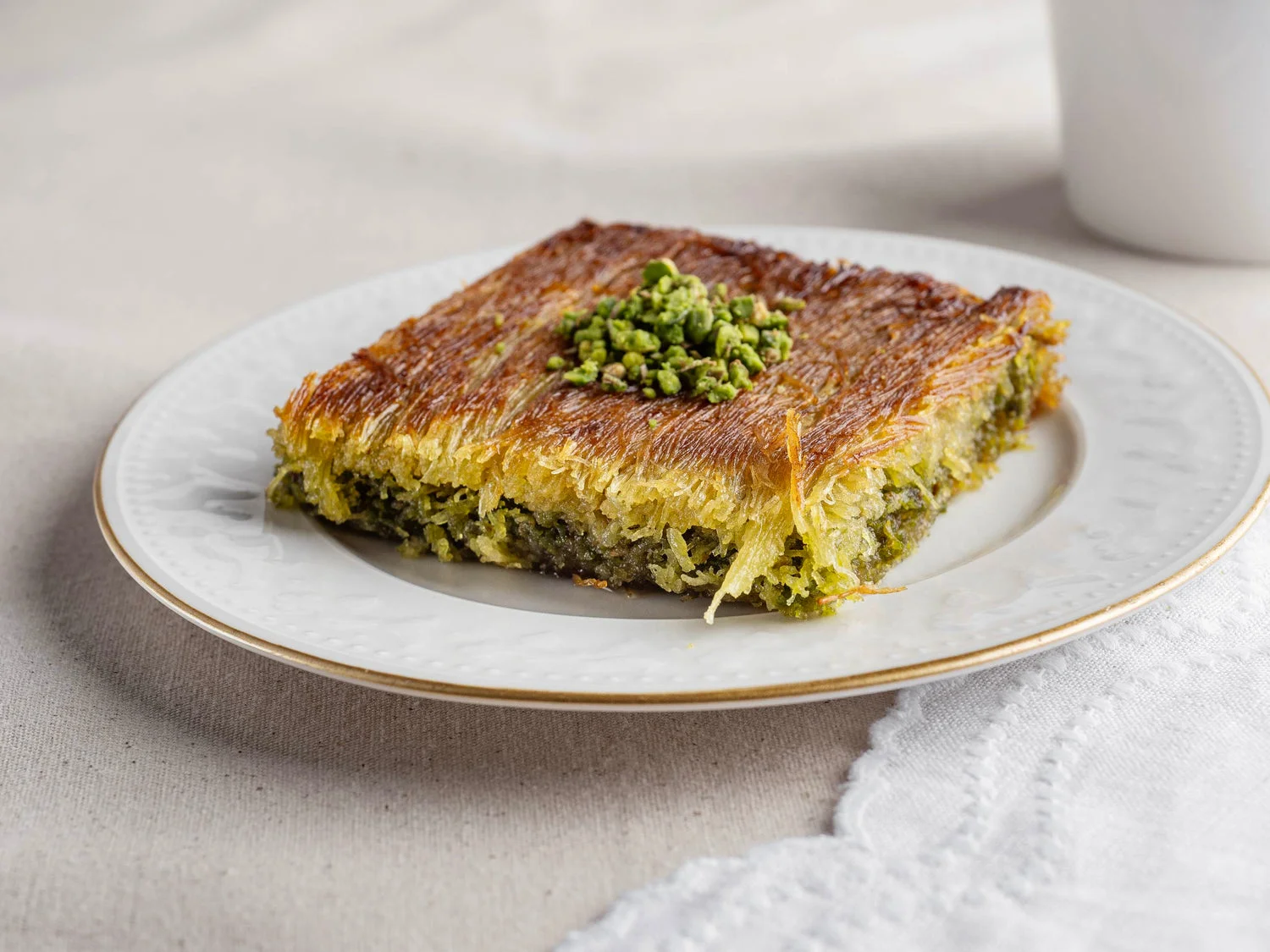
The word kadayıf (also spelled kadaif, kataifi, or kataif depending on which country you are in) refers to a family of pastry desserts built around a single distinctive ingredient: shredded, thread-like strands of dough that resemble fine vermicelli or angel-hair pasta, created through a specialised technique that has no real equivalent in Western pastry. Unlike baklava, which uses sheets of phyllo, kadayıf uses these delicate strands either loose (to be packed and baked in moulds) or rolled around fillings.
The two categories look completely different from each other and produce completely different eating experiences, yet they share the same fundamental dough and the same basic logic: nuts, butter, heat, and a sugar syrup poured over the finished product to sweeten and bind. Kadayıf is, in this sense, a cousin of baklava — related by technique and philosophy, but distinct enough to deserve its own conversation.
The Döküm: An Ancient Pouring Technique
The creation of kadayıf dough is one of the most visually remarkable processes in Turkish pastry-making, and one that cannot be replicated at home without specialist equipment. The technique is called döküm — "pouring" — and it involves forcing a thin batter of flour and water through a perforated container with a fine spout onto the surface of a large, continuously rotating hot plate. As the plate spins and the batter falls, it cooks on contact into hair-thin strands that are gathered by hand and set aside in loose, luminous nests.
The plate rotates at a carefully calibrated speed; too fast, and the strands break before they can be gathered. Too slow, and they stick together and lose their individual identity. The batter must be perfectly fluid — neither too thick nor too thin — and the operator must pour it with a consistent, sweeping motion to produce strands of uniform thickness. A skilled döküm artisan can produce kilograms of perfect kadayıf dough in a single session; a beginner's first attempt will look more like a scrambled egg. Like so much in Turkish pastry, it is a skill that lives in the hands and comes only with repetition.
"When the dough hits the hot plate and the strands appear in that instant — it is like watching the dessert being born. Every time, it is extraordinary."
A Complete Guide to the Six Varieties
The kadayıf family encompasses six distinct dessert types, each with its own structure, flavour profile, and cultural associations. Consider this your definitive guide.
| Variety | Structure | Filling | Texture |
|---|---|---|---|
| Tel Kadayıf | Loose strands packed flat in a tray | Walnuts or pistachios | Crispy outside, yielding within, syrup-kissed throughout |
| Burma Kadayıf | Strands rolled around nut filling, formed into a coil or roll | Whole or coarse-ground pistachios | Dense, crunchy exterior, deeply nutty centre |
| Hasır Kadayıf | Strands woven or basketed into a disc shape | Pistachios or walnuts | Intricate, delicate — almost lace-like when baked |
| Yuvarlak Kadayıf | Round, individual portions formed by hand | Pistachio or clotted cream | Compact and satisfying, with a clean cross-section |
| Ekmek Kadayıf | Baked as a flat cake from stale bread soaked in syrup | Kaymak (clotted cream) on top | Soft, dense, luxurious — utterly unlike the other varieties |
| Künefe | Cheese sandwiched between two layers of tel kadayıf, baked in individual copper pans | Fresh unsalted cheese (such as Hatay peyniri) | Crisp outside, melted and stretchy within — the only savoury-sweet variant |
Burma Kadayıf: The Crown Jewel
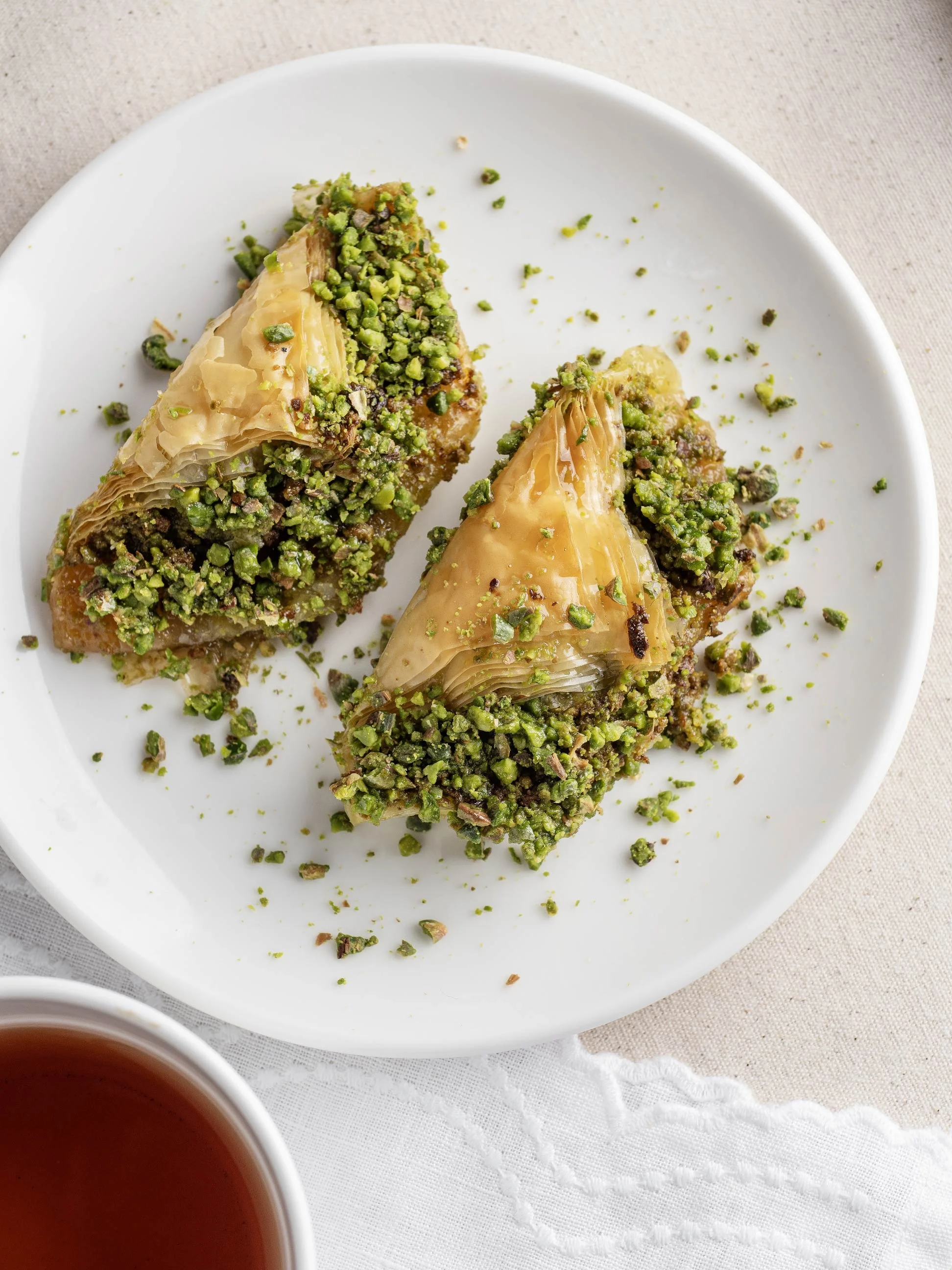
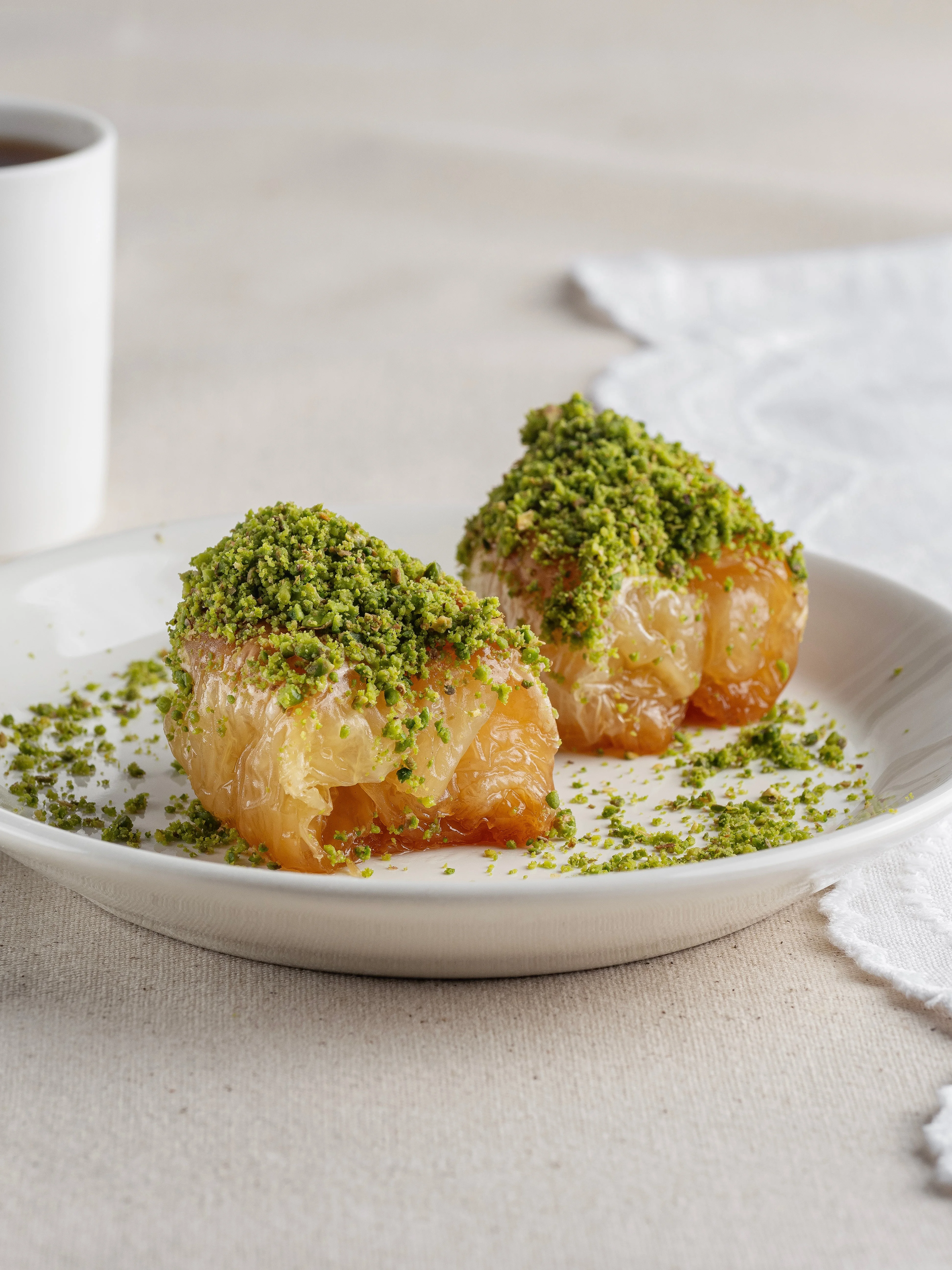
If baklava has a reigning king in the form of Antep fıstıklı baklava, kadayıf has a crown jewel of its own: Burma kadayıf, the rolled variety in which a generous quantity of coarse-ground or whole pistachios is packed tightly into a cylinder of shredded dough, which is then compressed, baked until golden, and saturated with cold syrup. The name Burma means "twisted" or "rolled" in Turkish, and the dessert lives up to this description visually — a tight, cylindrical form that is cut at the table into thick coins, each one showing a cross-section of nut and dough.
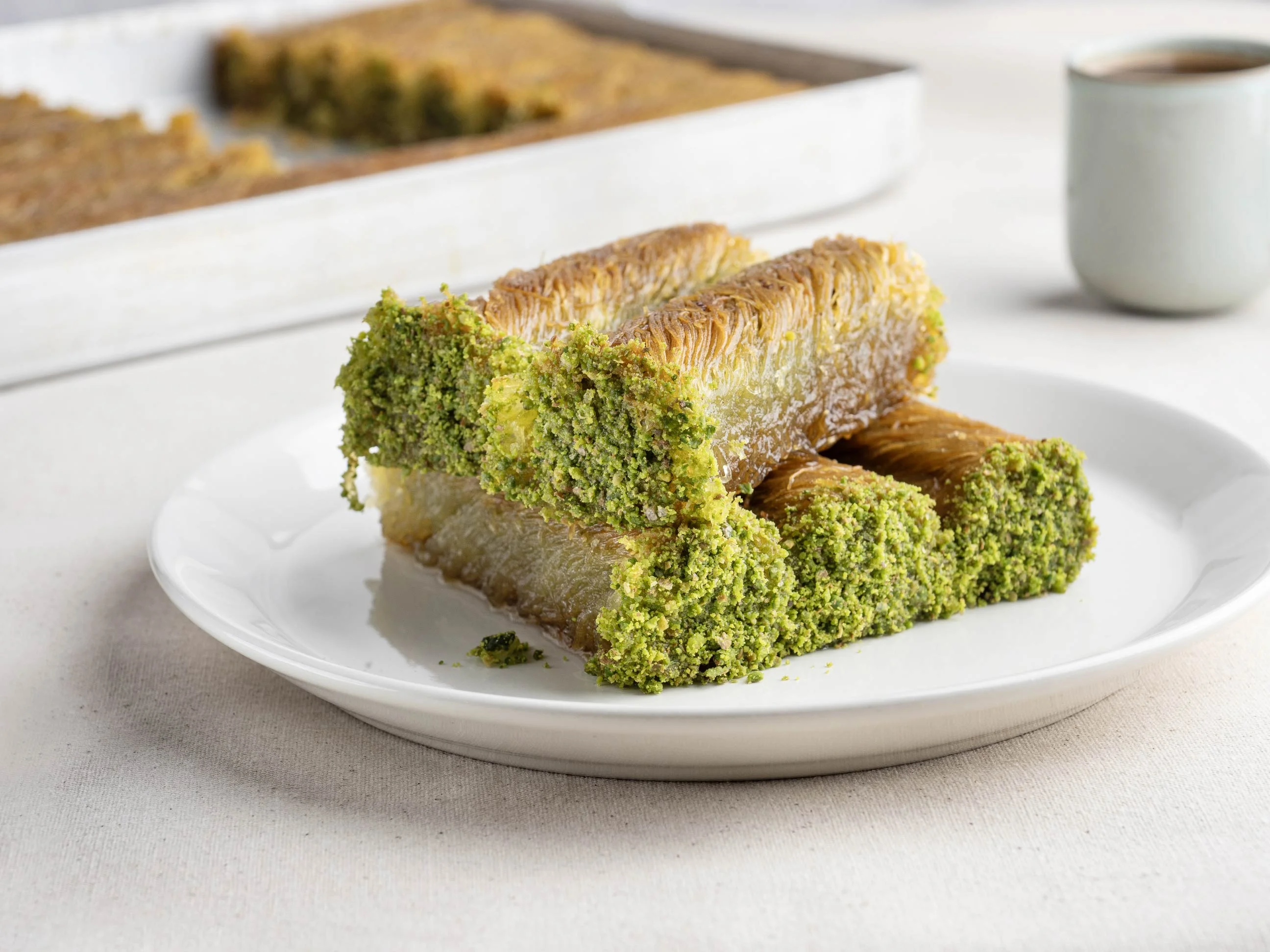
What makes Burma kadayıf technically demanding is the compression. The dough strands must be rolled under sufficient pressure to create a dense, cohesive cylinder without crushing so hard that they lose their individual texture. The filling must be packed generously — miserly filling is the commonest failing in commercially made Burma kadayıf — and the proportion of dough to nut must be balanced carefully. Too much dough and the dessert becomes dry and bland; too much nut and the cylinder cannot hold its form during baking.
Künefe: The Savoury Exception That Became a Legend
Künefe is the anomaly in the kadayıf family and the one that most reliably surprises people who encounter it for the first time. Where every other kadayıf variety is a straightforward sweet dessert, künefe is a savoury-sweet hybrid: a disc of fresh, unsalted cheese — traditionally the stringy, meltable Hatay peyniri or a similar young white cheese — sandwiched between two thin layers of tel kadayıf, baked in a small individual copper pan until the exterior is gold and the cheese inside is fully melted and gently stretching.
The syrup is poured on at the table, immediately before serving, over the still-sizzling dessert. The combination of the crisp, butter-rich dough, the molten and slightly salty cheese, and the cascade of sweet, warm syrup creates a flavour experience that resists simple categorisation. It is not a dessert in the conventional sense, and it is not a savoury dish. It occupies a flavour category of its own — a Turkish pastry equivalent of the French combination of salted butter caramel, or the Japanese preference for mildly sweet and savoury in the same mouthful.
How to Eat Kadayıf at Its Best
Kadayıf is at its absolute peak within minutes of being plated. Unlike traditional baklava, which actually improves over a few hours as the syrup penetrates and the flavours integrate, kadayıf is best eaten hot — or at least very warm. The contrast between the crisp exterior, which begins to soften as soon as the syrup is applied, and the warm, syrup-saturated interior is the essential experience. As it cools and the syrup fully absorbs, that textural contrast diminishes.
At Saytad, we serve tel and Burma kadayıf with a spoonful of kaymak — Turkish clotted cream — on the side, which cuts through the sweetness and adds a dairy richness that completes the experience. The kaymak should be at room temperature, never cold, so that it melts slightly on contact with the warm pastry. A small glass of unsweetened Turkish çay alongside provides the bitter contrast that brings out the full sweetness of the syrup.
One last piece of advice, from our kitchen to yours: do not be intimidated by kadayıf's reputation for technical complexity. You do not need to make the dough yourself to appreciate it. You need only to eat it properly — warm, fresh, with good cream and good tea — and you will understand immediately why this dessert, so long overshadowed by its more famous cousin, is beginning to take its rightful place as one of the great pleasures of Turkish pastry.